

American Phoenix
Arising from the Ashes of a Failing Democracy

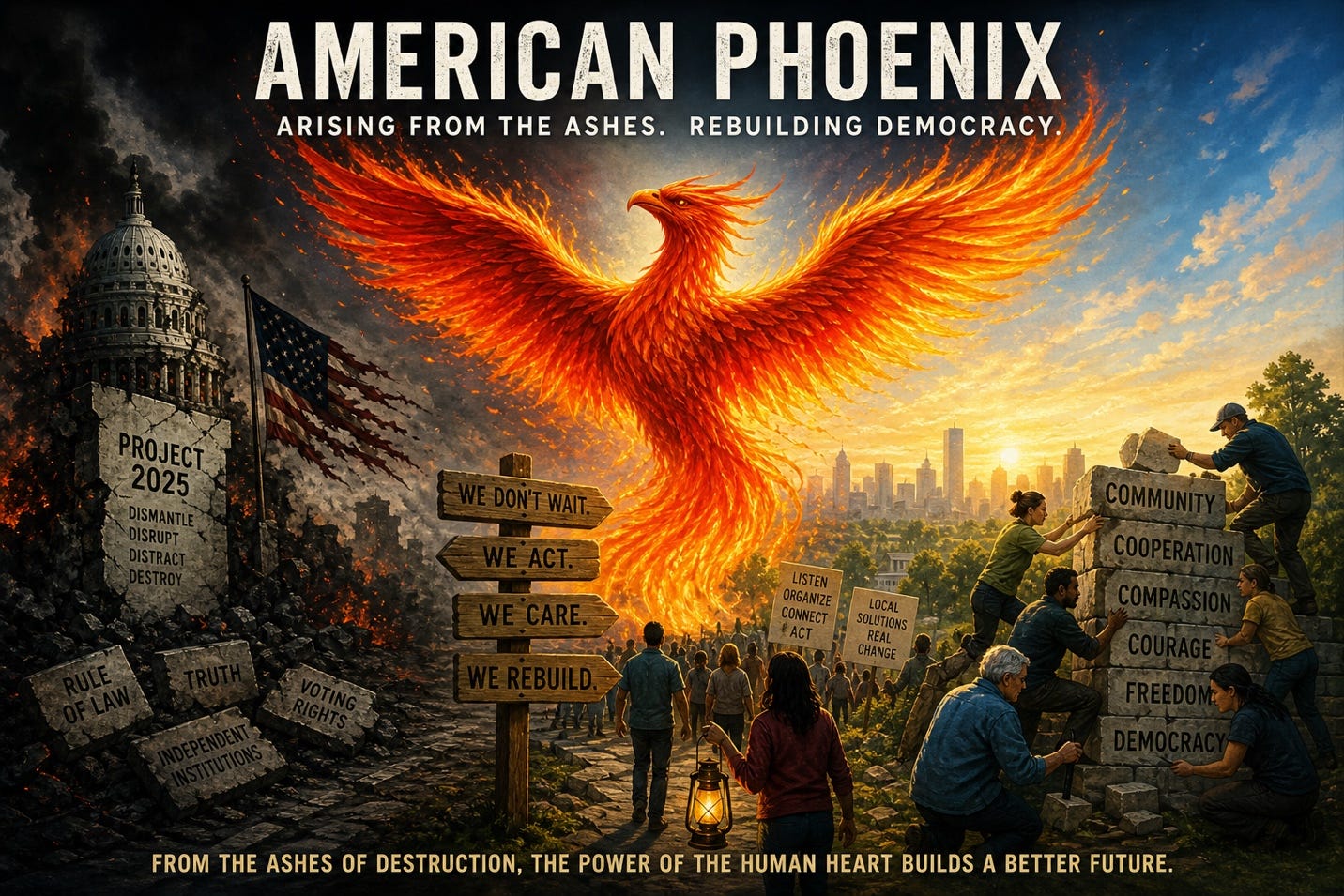
The story of the Phoenix: the Phoenix is a sacred bird which builds a nest only to have it consumed by fire—consuming the Phoenix itself. From the ashes, the Phoenix is reborn, resilient and transformed, radiant and ready to resume life. It is not simply a story of rebirth—it is a story of what must happen when something can no longer continue as it is.
There are moments in history when a nation is clearly under threat from a radically different form of governance. Project 2025, with Donald Trump as its candidate, was swept into power in the 2024 presidential election.
The Fire (Destruction)
He came to power with the clear goal of repurposing government to meet the requirements of Project 2025, shifting it from a government designed to serve the citizens of a democracy to a government designed to serve business corporations, and the economic elite. That required a radical change—a quiet coup—from a government supportive of the Constitution, the rule of law, and a balance of power between the executive, legislative, and judicial branches, each operating independently; to one centered in a unitary presidency with few effective constraints.
Quickly the process began: releasing prisoners connected to the 2021 insurrection and moving on from there to reconfigure the rule of law into something directed by the new president. The leadership of the military, the departments of government, and governmental institutions were removed and replaced by those who supported the president and the aims of Project 2025. There was a massive purge of the government bureaucracy, closing programs and cutting staff in others.
And then came the purges of immigrants—the often extra-legal rounding up and deportation of people, the building of large detention centers, actions frequently outside normal legal limits. ICE begins to take on the character of a domestic enforcement arm, increasingly directed from the top. The result is disruption, fear, and resistance from communities that see themselves under attack.
The purpose of Project 2025 was to reshape the machinery of governance in ways that make it far less accountable to democratic control. Institutions that once provided balance and restraint are weakened, bypassed, or hollowed out.
This is not unlike The Shock Doctrine by Naomi Klein, in which major shifts happen so quickly that the populace is disoriented and unable to react in time—watching as the structures it has long relied upon begin to fracture, and the assumptions that once guided its people no longer hold.
In such a landscape, elections themselves become uncertain—not just in outcome, but in their very existence as a reliable mechanism of choice. History reminds us that those seeking permanent power cannot afford to risk losing it. The temptation—and sometimes the strategy—is to ensure that meaningful challenges never arise.
At the center of this storm, as a tool of Project 2025, is a figure who has, since 2015, demonstrated an extraordinary ability to dominate the public space. Donald Trump has operated not only as a political actor, but as a force of disruption—flooding the landscape with noise, conflict, and constant motion. In such conditions, attention itself becomes fragmented, and clarity—essential to democratic decision-making—begins to erode.
The goal, it increasingly appears, is not popularity, but control. Not persuasion, but dominance.
The Ashes (Disorientation)
In the wake of such a transformation, a different kind of damage emerges—less visible, but equally dangerous.
Confusion sets in. The pace of events accelerates beyond our ability to process them. One crisis replaces another before the previous one can be understood. The result is fragmentation—not only of information, but of shared reality itself.
At the same time, the traditional tools of response begin to falter. Legal processes move slowly. Political systems require consensus that no longer exists. Bureaucratic structures, designed for stability, struggle to respond to rapid and coordinated disruption.
There is a growing sense—often unspoken—that the usual pathways no longer work.
That waiting for official approval, for institutional correction, or for the next election cycle may not be enough—and may, in fact, be too late.
The First Sparks (Human Response)
In moments like these, something else begins to stir—not from the top down, but from the ground up.
Imagine a ship taking on water. A leak has opened below the waterline. The people in steerage see it first. They recognize the danger.
They inform the captain. He sends someone down to see what has happened and report back to him, but he cannot come for two days. Meanwhile the passengers in steerage are noticing their shoes are getting wet.
When the official comes to check it out. He says, “It’s a leak, and we have a process to deal with that. I will make my report and get back to you.” And he leaves.
Two days pass and the passengers have not heard back from the official, but their feet are now definitely getting wet and they begin to worry.
Finally, someone comes down and says they have a process to solve the problem, but first they will need to have the official repair man come down and decide what is necessary to fix the problem.
That person comes the next day and takes a lot of notes. When asked when the repair will begin, he tells them that he will make his report and, once it is approved, he will requisition the materials and hire the workmen, but first the costs will have to be approved. After that the materials will be ordered, the workmen hired, a foreman appointed and then they will be ready to fix the leak
By now the water is ankle deep and beginning to rise faster.
Aware of how long the official process will take and aware of how fast the water is rising, it is clear that their survival probably depends on them taking events into their own hands.
They meet to find a solution. They must clearly fix the leak themselves without getting any kind of official permission. One person says they worked on the crew of another ship and understood how to fix leaks. Another person said he knew one of the crewmen who could get the necessary tools. Another person knew where to get the necessary patching materials.
They formed work crews to get the tools and materials and to devise a way to patch the leak which was now up to mid-calf and people were getting very scared.
They worked, the leak slowed and finally it stopped and they began to pump the water out.
Finally, an official came. He saw what they had done and shook his head and said this will all need to be removed and eventually replaced with approved materials by an approved crew.
When he left, they decided that if anyone came to take the patch off, they would likely keel haul them.
What matters is not that the solution is perfect. What matters is that it works—and that it is done in time
This is the nature of what might be called “cobbled solutions”—improvised, practical responses born of necessity. They do not wait for permission. They arise from the recognition that survival itself depends on action.
We see such responses emerging now in small and scattered ways. Communities organizing. Individuals stepping forward. Networks forming outside traditional structures. People choosing to act—not because they have been instructed to do so, but because they understand that they must.
The Phoenix (Reconstruction)
History offers many examples of this pattern.
When formal systems collapse or become unresponsive, people find ways to adapt. In different places and under very different circumstances—whether in war-torn regions, occupied societies, or movements for independence—ordinary individuals have often become the carriers of continuity, resilience, and renewal.
We saw the beginning of such a response in Minneapolis and elsewhere in response to ICE. We see this in the resilience of Gaza, in Lebanon, in Iran. We have seen it in Vietnam, in Iraq, and in societies recovering from Covid or natural disasters. All of these suggest something fundamental: the capacity for reconstruction does not reside solely in institutions. It resides in people.
What begins as improvisation can become structure. What starts as survival can evolve into a new form of organization. Out of the fragments of what has been damaged, something else can take shape.
An American Phoenix would not be a return to what was. It would be something different—built not only on laws and procedures, but on a renewed commitment to the underlying principles that gave those structures meaning: freedom, dignity, and shared responsibility.
At its core would be something less tangible, but more powerful—the energy of the human heart. The willingness to care, to connect, to act not only for oneself but for the larger whole.
The Choice Before Us
And so, we arrive at a moment of decision.
Do we wait—for institutions to recover, for clarity to return, for someone else to act?
Or do we begin—imperfectly, collectively, and without guarantees—to do what we can with what remains?
The survival of any democratic system has never depended solely on its formal structures. It has always depended on the people who inhabit it—their willingness to participate, to take responsibility, and, when necessary, to step beyond established roles.
If the systems we have relied upon are weakening, then the question is not simply whether they can be restored.
It is whether we are willing to become something more than we have been.
Not spectators. Not merely voters at distant intervals.
But participants in the ongoing creation of the society in which we live.
The Phoenix does not wait to be rebuilt.
It rises because something within it insists on life.
And perhaps that is where we are now.
At the edge of destruction—or the beginning of renewal.
